9am - 5pm
         404.478.3017        

All posts by Adminrf

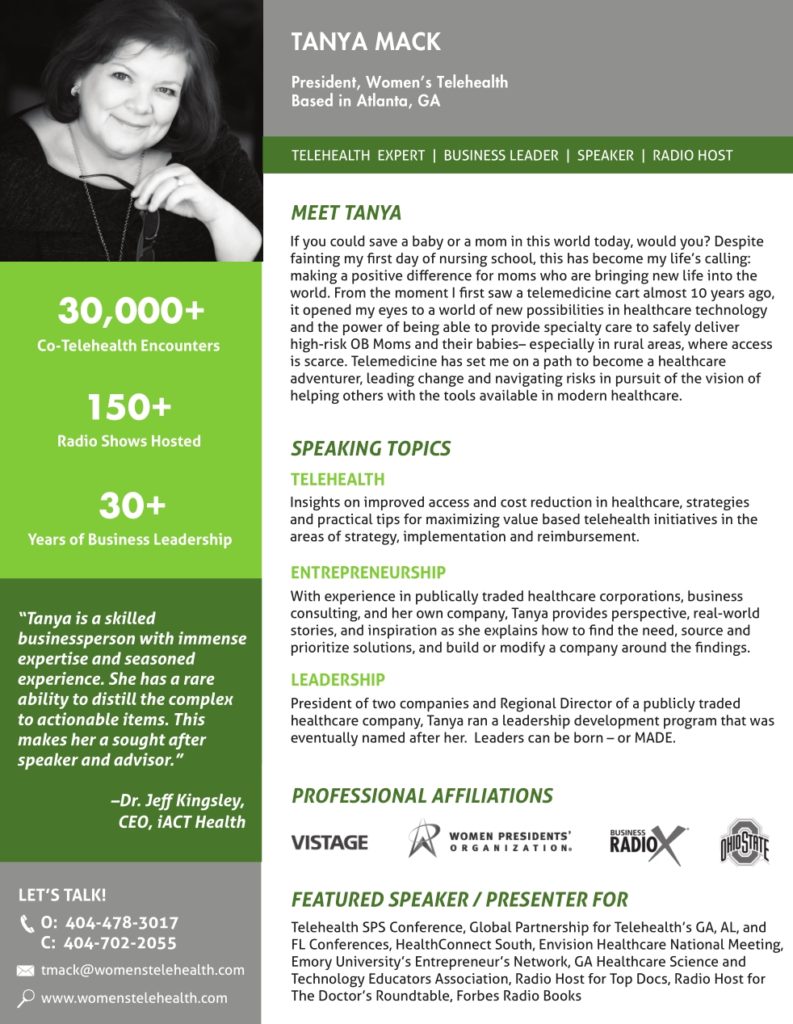
Eager to Share My Passions – Telehealth, Entrepreneurship, Leadership

Call me a healthcare adventurer! I’m always pursuing my vision to help others! Above all, my goal is to lead industry change with the tools available in modern healthcare.

I welcome your invitation to serve as a guest speaker or advisor! It would be an honor to share some of the varied expertise I’ve gained through seasoned experience. See bio for details.
~Tanya Mack, President

Read More

Information Asymmetry vs. Parity

Renowned author Daniel Pink was a featured keynote speaker this week at the Women President’s Organization’s Annual Meeting in Charlotte, and Women’s Telehealth was there as he shook up the audience.

His main message was the far-reaching effects of information access available to almost anyone, anywhere, instantaneously. This playing field is leveled as we move through the world enrolling and influencing others around us. Information asymmetry is shifting to information parity.

To adjust to this shift, Dan suggested three strategies to consider- his version of the ABC’s:

Attunement: To get alignment, we must be more disciplined to understand another’s point of view.

Buoyancy: We must cultivate our ability to overcome “an ocean of rejection” and remain afloat in tough times.

Clarity: Expertise is now obsolete since we can choose to education ourselves for free online for almost anything. We have so much data at our fingertips, but now the need is the ability to sift through it and “problem find” and shift from accessing information to curating it.

As this shift rolls on, it will change our relationships, our work patterns, our productivity, our environments and our daily tools. Whether we like it or not, Dan tells us 41% of our day AT LEAST is spent influencing or persuading in some way.

Time to make some adjustments?

~Tanya Mack, President

Read More

Addiction and Babies? Help Us Raise Awareness!

April is Alcohol Awareness Month in the U.S. and a perfect time to raise awareness around prenatal substance abuse and how this affects both the fetus and the newborn. The U.S. has seen a dramatic increase in the past ten years in babies exposed to drugs and alcohol in the womb before birth.  Babies that are born to an addicted mother can suffer from withdrawal once born. Babies can’t consciously abstain. We know this and see stories about this in the news every day. 

The effects are far reaching and for the baby in utero, may result in low birth weight, slow growth, altered development and in some, lifelong health problems.  After the baby is born, Fetal Alcohol Spectrum Disorder (FASD) and Neonatal Abstinence Syndrome (NAS) may require intense intervention in a hospital, perhaps even NICU setting.

Neonates may be exposed to a wide range of substances and it’s hard to know what they may be exposed to due to self-reporting, not knowing the exact components of illicit drugs and wide range of prescription drugs the mother may be taking during pregnancy. All babies do not have withdrawal depending on the length of exposure, the cumulative dose and the baby’s gestational age at birth. Full term babies are more likely to experience withdrawal than preemies.

Symptoms for babies who are experiencing withdrawal often show up within 72 hours of birth, but may not become apparent until a few weeks after delivery. Specific symptoms may vary but include:

  • Irritability 
  • Poor Feeding    
  • High Pitched Crying
  • Fever  
  • Diarrhea 
  • Vomiting
  • Seizures  
  • Chronic pain

Most babies get better initially in 5-30 days and treatments for these conditions include:

  • Environmental manipulation (swaddling, holding, low lighting, mother-baby bonding
  • Pharmacologic therapy to wean them off of the  addictive substance
  • Social service intervention as family situations may be complex
  • Providing empathy and support  
  • Close follow up post hospitalization and these substances may affect their development

As with many health care issues, prevention is preferred over later intervention. Early intervention is a critical path to mitigating problems.  Consider:

  • If you are pregnant and on prescriptive drugs that may affect the fetus, notify your provider.
  • If you are pregnant and using, do not quit cold turkey without the direction of your provider, as it may negatively affect the baby.  Ask about medically-assisted treatment.                                           

To help us raise awareness, SHARE THIS MESSAGE to get information into the hands of people dealing with pregnancy and substance abuse.
~Tanya Mack, President
Read More